You Will Likely Lose That Trend From Prediction
A trend is the part of the future that prediction cannot see, and the habit of predicting, waiting and positioning is exactly what loses it. Here is what the scoring experiments, the Google Flu collapse and two famous Reddit losses teach about noticing instead.
Written by Victor Ohachor on
On this page
"Prediction is very difficult, especially about the future."
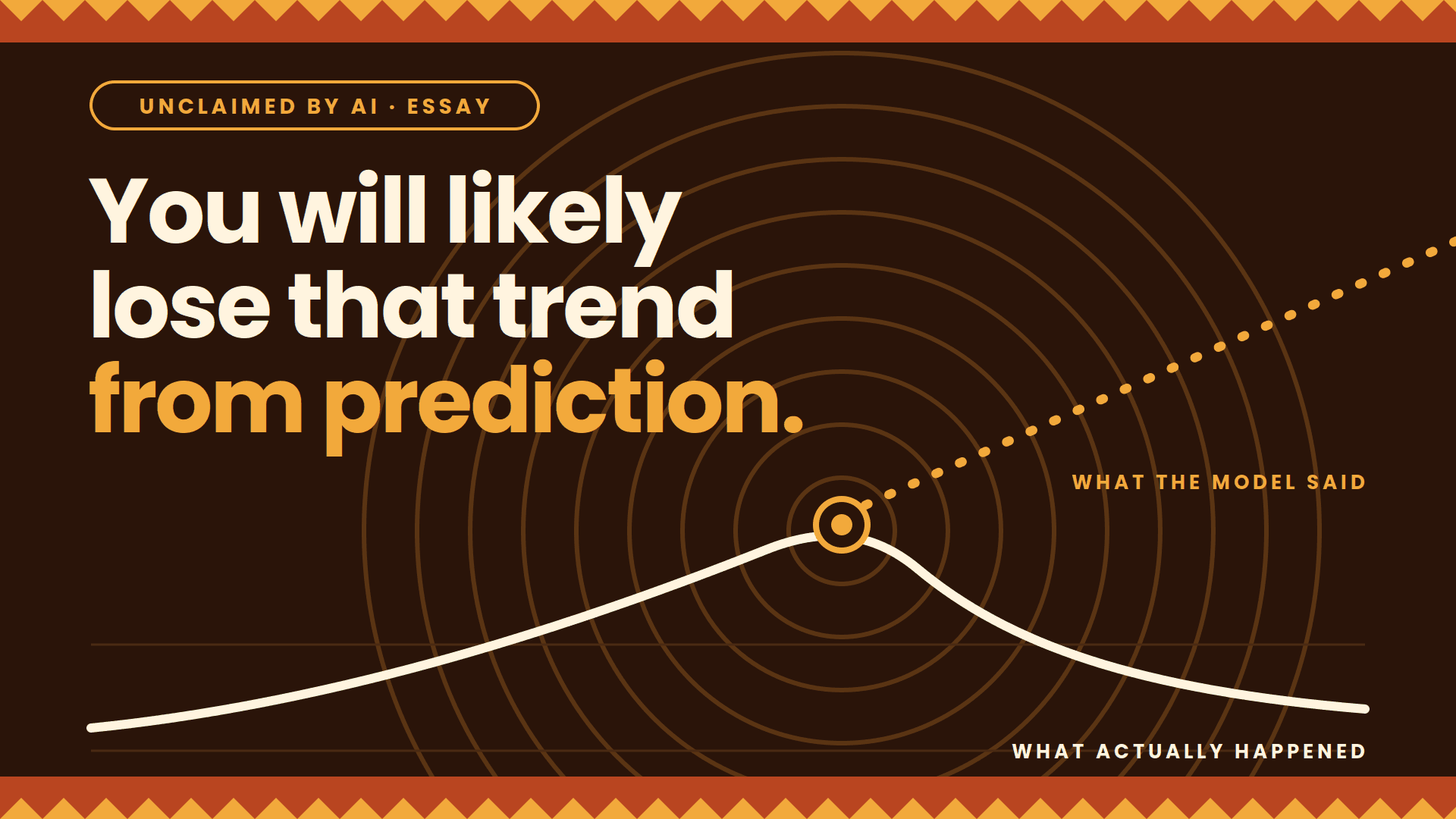
The title of this post is a warning with a mechanism in it. Not that predictions are often wrong, everyone knows that, and complaining about wrong predictions is a sport older than forecasting itself. The claim is sharper: for a trend, the act of predicting is one of the things that loses it to you. You will likely lose that trend from prediction itself.
Three mechanisms, all of them measured by somebody. Prediction cannot see the break coming. Being right about the break still loses you the ride. And once everyone predicts the same trend, the prediction starts eating the trend. At the end I will argue for the unglamorous replacement: noticing things early, cheaply, and in plural.
Why Is a Trend Harder Than an Event?
An event question sits on top of a structure that mostly persists. For example:
- Will this number print higher than that number next month?
- Will that vote happen before that deadline?
The world changes slowly enough that yesterday carries real information about tomorrow, and that is exactly the condition under which forecasting works.
A trend is a change in the structure. It is the moment the line bends, and bending is the one thing a straight line will never tell you about.
The forecasting competitions make this uncomfortable in the nicest way. Across the M series, the great horse races of the field, the answer to "what forecasts best" kept moving. In M1 through M3, simple statistical methods matched or beat the sophisticated ones (Makridakis & Hibon, 2000). In M4, the most accurate entries were mostly combinations, with one hybrid of statistics and machine learning as the surprise (Makridakis et al., 2020). In M5, machine learning finally took the whole podium: all fifty top entries were pure ML methods, beating every statistical benchmark and their combinations (Makridakis et al., 2022). Anyone still repeating "simple always wins" in 2026 is quoting a result that expired in 2020.
But notice what survived every competition, the way a trend does not. Combining helps. And the winning methods win at continuation. M5 was hierarchical retail sales data, rich and regular, and the organizers themselves noted that whether machine learning keeps dominating outside such data remains an open question (Makridakis et al., 2022).
A review of forecasting in operational research concluded that the damped trend can "reasonably claim to be a benchmark forecasting method for all others to beat" (Fildes et al., 2008). Think about what that says. The method to beat, in the science of trends, is the one that bets against the trend continuing at full strength.
And when the line actually bends, the models slide right past it. In the German and Polish COVID forecast hub, most models, the ensemble included, handled turns in the trend poorly (Bracher et al., 2022). Peaks are trends ending. Continuation is what models do.
What the Scoring Experiments Actually Found
Philip Tetlock tracked 284 political and economic experts across roughly 82,000 forecasts over two decades and scored them like weather forecasts (Tetlock, 2005). The experts barely beat the dart-throwing chimpanzees, and they did not beat the simple mechanical extrapolation of the recent past. What did separate the better forecasters was not what they knew but how they thought: the "foxes," who borrowed from many small models and updated constantly, beat the "hedgehogs," who knew one big thing. One thing that consistently went with worse accuracy was fame.
Then somebody made it trainable. In the intelligence community's ACE tournament from 2011 to 2015, the Good Judgment Project beat the tournament's control group by more than fifty percent (Mellers et al., 2014). Training alone added roughly ten percent to accuracy (Tetlock et al., 2014), and teams beat individuals by around twenty-three percent (Mellers et al., 2014).
| Experiment | What it found | What it means for trends |
|---|---|---|
| Expert Political Judgment, 1984 to 2003 (Tetlock, 2005) | 284 experts, about 82,000 forecasts, barely above chance and below simple extrapolation | Expertise does not see the bend coming |
| IARPA ACE tournament, 2011 to 2015 (Mellers et al., 2014) | Trained teams beat the control group by over 50% | Skill exists for events with fast feedback |
| M competitions, 1982 to 2020 (Makridakis et al., 2020; 2022) | Simple won early, combinations next, ML last; combining always helped | Continuation is nearly solved; bends are not |
| Google Flu Trends, 2008 to 2015 (Lazer et al., 2014) | Missed the 2013 peak by 140%; shut down in August 2015 | Big data extrapolated the seasonal trend and missed the break |
| Recency heuristic vs Google Flu Trends (Katsikopoulos et al., 2022) | "This week equals last week" beat GFT, mean absolute error 0.20 against 0.38 | One recent data point beats a trained trend model in fast change |
The Google Flu Trends row deserves a moment, because it is the cleanest natural experiment we have on trend prediction. Launched in 2008, it predicted flu from search queries. In February 2013 it projected more than double the proportion of doctor visits that the CDC eventually recorded, had overestimated for 100 of the previous 108 weeks, missed the 2013 peak by 140 percent, and never recovered (Lazer et al., 2014; Lazer & Kennedy, 2015). The postmortem named two culprits: big data hubris and algorithm dynamics, since the platform under the data kept changing shape.
And then the punchline, delivered in 2022 with impeccable comic timing. Katsikopoulos, Şimşek, Buckmann and Gigerenzer compared Google Flu Trends against the recency heuristic, a "model" consisting of exactly one assumption: this week's flu level equals last week's. Over the whole life of the system, the one data point won, mean absolute error 0.20% points against 0.38. The trend model trained on years of data lost to the rule that refuses to predict trends at all.
What About the Machines? A Status Check From October 2026
The machine chapter is moving fast, so here is where it stands today rather than where it stood when you heard about it.
ForecastBench, the dynamic benchmark run by the Forecasting Research Institute, asks AI systems to forecast real unresolved questions and scores them against human superforecasters (Karger et al., 2025). The first results were humbling for the machines: the top expert humans beat the best language models decisively. Improvement since has been steady, about 0.016 Brier points a year, and the institute projected parity around November 2026 with a wide confidence window.
Reality delivered early. In May 2026 a Google DeepMind submission took first place on the dataset half of the benchmark, slightly ahead of the superforecaster median, while trailing on the market half. In July 2026 the institute reported that AI models have likely reached parity with superforecasters overall, a result where the null hypothesis of equal accuracy could not be rejected (Forecasting Research Institute, 2026). The same report said an AI system had ranked above the superforecaster median on market questions for the first time, which matters because that half asks for judgment about one-off events. The institute also cautioned that the results fit parity better than outperformance, and that its superforecaster baseline dates from 2024. On the leaderboard this week, the superforecaster median is still the name at the top of the combined table.
This tracks what the research said from the other direction. A retrieval augmented system already neared the human crowd aggregate on competitive forecasting platforms in 2024 (Halawi et al., 2024). But parity on event questions is not the ability to see a break, because both the models and the crowd are reading the same continuing world. The benchmark that would settle this post does not exist yet: a scored tournament on turning points.
Meanwhile the humans disagree plenty on their own. Asked when machines would outperform humans at every task, 2,778 AI researchers produced a median of 2047, thirteen years earlier than the same survey's median a single year before (Grace et al., 2025). The trend in their predictions moved faster than the trend they were predicting. Ask 226 finance professors what stocks will return over thirty years and the answers run from 1 to 15 percent a year (Welch, 2000). The room full of experts is a crowd with a very wide spread, which is precisely the condition under which aggregation works and punditry fails.
Can You Be Right About the Trend and Still Lose It?
Suppose you are. Suppose you see the bend before everyone, and correctly. The ride can still kill you, and this is where the title gets its teeth.
Long-Term Capital Management was run by two Nobel laureates in economics and the best bond traders of their generation. Its trades were convergence bets: prices that had drifted apart would come back together. The thesis was not foolish. In August 1998 the fund lost 44 percent of its value in a single month, including 553 million dollars on one day, and by September it had lost over 90 percent of the capital it had held in January. On 23 September 1998, fourteen banks put in 3.6 billion dollars to stop the fire sale, taking 90 percent of the fund (Fleming & Liu, 2019). The partners' stake was diluted to a tenth.
And here is the detail that should be framed on a wall. In the year after the rescue, the fund earned about ten percent before being liquidated. The convergence happened. The trend they called arrived, wearing a black armband, slightly too late to matter to them.
The internet has since run controlled experiments on a close cousin of this theme, with receipts and screen recordings. To be fair, neither of the next two was betting on a trend. They were betting on a structure, and the structure charged them for the path. In January 2019, a redditor known as 1RONYMAN sold a box spread on Robinhood, a structure he described as "risk-free," turning a 5,000 dollar account into a position of roughly a quarter million dollars. Options assignment, the one path the model shrugged at, hit him. The realized loss approached 2,000 percent of the account, and Robinhood banned box spreads on the platform (MarketWatch, 2019).
Then in October 2019, u/ControlTheNarrative found a leverage loophole in the same app, turned a 2,000 dollar deposit into about 50,000 dollars of buying power, and spent it on Apple puts. The position lost nearly 45,000 dollars within roughly two minutes of the market open, on camera, producing a single involuntary syllable that the subreddit still uses as a unit of measurement (Los Angeles Times, 2019). The glitch was patched within the week. The syllable remains.
| Who | What they saw | What actually happened |
|---|---|---|
| Long-Term Capital Management, 1998 | Convergence trades that would pay | Lost over 90% of capital in months; positions paid after the rescue |
| u/1RONYMAN, January 2019 | A "risk-free" box spread | Assignment risk turned a 5,000 dollar account into a loss approaching 2,000% |
| u/ControlTheNarrative, October 2019 | Apple would move his way on earnings | Nearly 45,000 dollars gone in about two minutes at the open |
The pattern across all three: the destination was arguable, sometimes even correct, but the path set the price of admission higher than the account could pay. There is a famous line about this, usually given to Keynes: "the market can remain irrational longer than you can remain solvent." Quote Investigator traced the earliest print to A. Gary Shilling's Forbes column in February 1993, so the line about being too early is itself an example of a prediction confidently credited to the wrong source (Quote Investigator, 2011).
Being early is expensive in ordinary business too. Across 200 companies, Bill Gross found timing accounted for 42% of the difference between success and failure, ahead of team at 32% and the idea itself at 28% (Gross, 2015). And the historical record on the first movers of a trend is brutal: in a study of roughly 500 brands across 50 categories, about 47% of market pioneers failed outright, their average market share around 10%, while the eventual leaders typically entered an average of 13 years after the pioneers (Golder & Tellis, 1993). The people who chase predicted trends and the people who ride them first are often the same funeral.
What Happens When Everyone Makes the Same Prediction?
Now the third mechanism, and the place where the title of this post turns out to be a citation.
In 1948 Robert K. Merton published "The Self-Fulfilling Prophecy" in The Antioch Review, describing how a false definition of the situation can evoke behavior that makes the false conception come true (Merton, 1948). Banks fail because people believe banks will fail. Bubbles inflate because everyone believes they are early.
But in a footnote he names the mirror image, and this post is named after it: the "suicidal prophecy," which so alters behavior from what would have been its course that the prophecy fails to be borne out. A prediction of a trend, widely believed, changes what everyone does until the trend is crowded, arbitraged, or starved. You will likely lose that trend from prediction, in Merton's precise sense.
The measurement version of the same idea is Goodhart's law. Charles Goodhart's 1975 formulation ran: "any observed statistical regularity will tend to collapse once pressure is placed upon it for control purposes." Marilyn Strathern sharpened it in 1997 into the version everyone quotes: "when a measure becomes a target, it ceases to be a good measure." A predicted trend becomes a target, and then a measure, and then something else.
George Soros built a theory of markets out of the same loop. Every bubble, he argued, has two components: a real trend and a misconception about that trend, reinforcing each other until the gap becomes impossible to sustain (Soros, 1987). Booms are slow, busts are abrupt, because leverage and forced liquidation compress the exit into a doorway. The prediction of the trend is part of the machinery of the trend, and part of the machinery of its death.
So What Do We Do Instead?
If predicting trends is the trap, what is the practice? Nothing glamorous, and all of it measurable.
Notice usage before you notice narratives. In 2010 Kevin Systrom and Mike Krieger had Burbn, a check-in app going nowhere, with one feature people actually used: photos (Roberts, 2014). They cut everything except photo sharing and had a new app in about eight weeks, which launched in October 2010 and reached roughly 100,000 users in its first week (TechCrunch, 2010; WIRED, 2014). Two years later, the team behind a game called Glitch noticed that the internal chat tool they had built to survive a distributed studio was more valuable than the game. Glitch closed in December 2012; Slack previewed in August 2013 and went public in February 2014 (TechCrunch, 2019). Neither team predicted a trend. Both noticed one that was already happening in their own logs. Noticing does not get you out of mechanism two, though. Seeing early still means being early, which is why the last practice below matters as much as this one.
Aggregate instead of forecast. In 1906 Francis Galton collected 787 guesses at the dressed weight of an ox at a country fair. The middlemost guess missed by under one percent, and a later re-analysis found the mean of the crowd was exactly right (Galton, 1907; Wallis, 2014). Not one guesser predicted the weight. The aggregation of many independent errors did. This is the same reason trained forecast teams beat individuals and combinations win the M competitions. Many cheap signals, combined, beat one grand prediction.
Damp your assumptions. Assume continuation, because that is what the data mostly does, but bend the line toward flat as the horizon grows, because that is what the data sometimes does (Gardner & McKenzie, 1985). When the recency heuristic beats the trend model, the lesson is not that trends are unknowable. The lesson is to stand closer to the present.
Keep being early survivable. If timing explains 42 percent of success and failure (Gross, 2015), then the strategy is not to predict timing better. It is to structure your bets so timing can be wrong twice before it sinks you. Small positions, many of them, updated as usage arrives.
Listen to the fringe of your market. Clayton Christensen's census of the disk drive industry found the incumbents were held captive by their best customers, who kept asking for better versions of what existed. Two thirds of the fourteen-inch makers never built an eight-inch drive at all, and every one of them eventually left the industry (Christensen, 1997). The next form factor always looked like a worse product for someone who was not your customer yet. (The theory has taken real criticism since, and the New Yorker's 2014 demolition is worth reading as counterweight. The pattern of the fringe outlasting the core still holds.)
Instead of a Closing
So here is the practice instead of a summary. Stop asking what the trend will be. Ask what three people said this week that surprised you. Ask which feature people are using wrong in a way that works. Ask what a small sample of reality says that your model of reality does not. Those questions have answers today, and today is the only date where a trend can actually be caught.
The trend everyone can already name is the one you have already lost.
References
Bracher, J., Wolffram, D., Deuschel, J., et al. (2022). National and subnational short-term forecasting of COVID-19 in Germany and Poland during early 2021. Communications Medicine, 2, 136.
Christensen, C. M. (1997). The innovator's dilemma: When new technologies cause great firms to fail. Harvard Business School Press.
Fildes, R., Nikolopoulos, K., Crone, S. F., & Syntetos, A. A. (2008). Forecasting and operational research: A review. Journal of the Operational Research Society, 59(9), 1150-1172.
Fleming, M. J., & Liu, W. (2019). Near failure of Long-Term Capital Management. Federal Reserve History. https://www.federalreservehistory.org/essays/ltcm-near-failure
Forecasting Research Institute. (2026, July 16). AI models have likely reached parity with superforecasters on ForecastBench. https://forecastingresearch.substack.com/p/ai-models-have-likely-reached-parity
Galton, F. (1907). Vox populi. Nature, 75, 450-451.
Gardner, E. S., & McKenzie, E. (1985). Forecasting trends in time series. Management Science, 31(10), 1237-1246.
Golder, P. N., & Tellis, G. J. (1993). Pioneer advantage: Marketing logic or marketing legend? Journal of Marketing Research, 30(2), 158-170.
Goodhart, C. (1975). Monetary relationships: A view from Threadneedle Street. Papers in Monetary Economics, Reserve Bank of Australia.
Grace, K., Stewart, H., Sandkühler, J. F., Thomas, S., Weinstein-Raun, B., Brauner, J., ... Korzekwa, R. C. (2025). Thousands of AI authors on the future of AI. Journal of Artificial Intelligence Research, 84. https://doi.org/10.1613/jair.1.19087
Gross, B. (2015). The single biggest reason why startups succeed. TED2015. https://www.ted.com/talks/bill_gross_the_single_biggest_reason_why_start_ups_succeed
Halawi, D., Zhang, F., Yueh-Han, C., & Steinhardt, J. (2024). Approaching human-level forecasting with language models. Advances in Neural Information Processing Systems, 37.
Karger, E., Bastani, H., Yueh-Han, C., Jacobs, Z., Halawi, D., Zhang, F., & Tetlock, P. E. (2025). ForecastBench: A dynamic benchmark of AI forecasting capabilities. https://arxiv.org/abs/2409.19839
Katsikopoulos, K. V., Şimşek, Ö., Buckmann, M., & Gigerenzer, G. (2022). Transparent modeling of influenza incidence: Big data or a single data point from psychological theory? International Journal of Forecasting, 38(2), 613-619.
Lazer, D., & Kennedy, R. (2015, October 1). What we can learn from the epic failure of Google Flu Trends. WIRED. https://www.wired.com/2015/10/can-learn-epic-failure-google-flu-trends
Lazer, D., Kennedy, R., King, G., & Vespignani, A. (2014). The parable of Google Flu: Traps in big data analysis. Science, 343(6176), 1203-1205.
Los Angeles Times. (2019, November 5). Robinhood traders discovered a glitch that gave them 'infinite leverage'. https://www.latimes.com/business/story/2019-11-05/robinhood-traders-discovered-a-glitch-that-gave-them-infinite-leverage
Makridakis, S., & Hibon, M. (2000). The M3-Competition: Results, conclusions and implications. International Journal of Forecasting, 16(4), 451-476.
Makridakis, S., Spiliotis, E., & Assimakopoulos, V. (2020). The M4 competition: 100,000 time series and 61 forecasting methods. International Journal of Forecasting, 36(1), 54-74.
Makridakis, S., Spiliotis, E., & Assimakopoulos, V. (2022). The M5 accuracy competition: Results, findings, and conclusions. International Journal of Forecasting, 38(4), 1346-1364.
MarketWatch. (2019, January 22). Trader says he has no money at risk, then promptly loses almost 2,000%. https://www.marketwatch.com/story/trader-says-he-has-no-money-at-risk-then-promptly-loses-almost-2000-2019-01-22
Mellers, B., Ungar, L., Baron, J., Ramos, J., Gurcay, B., Fincher, K., ... Tetlock, P. E. (2014). Psychological strategies for winning a geopolitical forecasting tournament. Psychological Science, 25(5), 1106-1115.
Merton, R. K. (1948). The self-fulfilling prophecy. The Antioch Review, 8(2), 193-210.
Quote Investigator. (2011, August 9). Quote origin: The market can remain irrational longer than you can remain solvent. https://quoteinvestigator.com/2011/08/09/remain-solvent
Quote Investigator. (2013, October 20). Quote origin: It's difficult to make predictions, especially about the future. https://quoteinvestigator.com/2013/10/20/no-predict
Roberts, D. (2014, October 10). How Kevin Systrom got started. Fortune. https://www.fortune.com/2014/10/10/how-kevin-systrom-got-started/
Soros, G. (1987). The alchemy of finance. Simon & Schuster.
Strathern, M. (1997). 'Improving ratings': Audit in the British university system. European Review, 5(3), 305-321.
TechCrunch. (2010, November 8). Instagram: A pivotal pivot. https://techcrunch.com/2010/11/08/instagram-a-pivotal-pivot/
TechCrunch. (2019, May 30). The Slack origin story. https://techcrunch.com/2019/05/30/the-slack-origin-story
Tetlock, P. E. (2005). Expert political judgment: How good is it? How can we know? Princeton University Press.
Tetlock, P. E., Mellers, B. A., Rohrbaugh, N., & Chen, E. (2014). Forecasting tournaments: Tools for increasing transparency and improving the quality of debate. Current Directions in Psychological Science, 23(4), 290-295.
Wallis, K. F. (2014). Revisiting Francis Galton's forecasting competition. Statistical Science, 29(3), 420-424.
Welch, I. (2000). Views of financial economists on the equity premium and on professional controversies. The Journal of Business, 73(4), 501-537.
WIRED. (2014, October 20). Why Instagram worked. https://www.wired.com/2014/10/why-instagram-worked
Questions people actually ask
Why do predictions lose you the trend?
A predictor extends the past, and a trend is the moment the past breaks. By the time a pattern is clear enough to predict, the interesting part is behind you, and the forecast then serves the continuation rather than the change. Add the path risk of being early and the crowding of everyone predicting the same thing, and the habit of predicting is itself what costs you the trend.
Can AI predict trends better than people can?
Not at the turning points, which is where trends live. On ForecastBench, AI systems reached parity with elite human forecasters on binary event questions by mid 2026, but the researchers running the benchmark observed that the gap between humans and models shows up in the rare moments of disagreement, and those moments are exactly where the next trend announces itself. Machine forecasting still extrapolates, and trends are the thing extrapolation misses.
What should I do instead of predicting a trend?
Notice small signals before they are named, the strange query, the feature people overuse, the complaint that repeats in one week. Aggregate many weak signals instead of trusting one strong forecast, keep your assumptions damped rather than linear, and keep any position small enough that being early does not kill you. Speed of noticing beats accuracy of forecasting.