When AI Assistants Disagree About Your Name
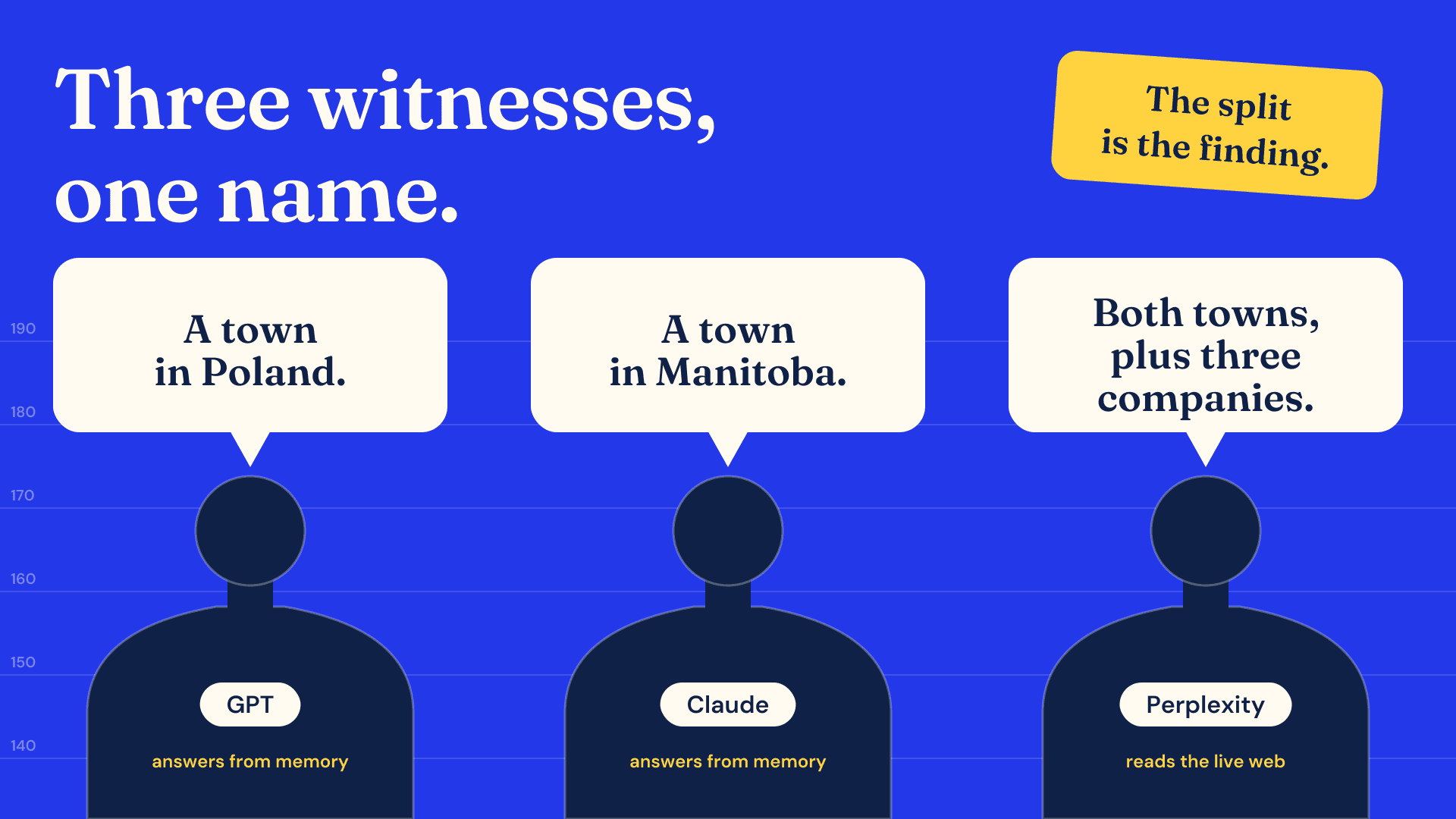
One name was a town in Poland to GPT, a town in Manitoba to Claude, and a mix of towns and companies to Perplexity. When the AI panel disagrees, don’t average the answers into a shrug, because the split is the finding.
Written by Victor Ohachor on
On this page
In my collision study, one name was a town in Poland to GPT, a town in Manitoba to Claude, and both towns plus three companies to Perplexity. Another name was a Brazilian scrap-metal dealer to two of the models, while the third saw a given name and a handful of compressor brands. Same name, same bare question, and not one testimony that agreed with another.
When a panel disagrees like this, the tempting move is to average the answers into a polite shrug. Please resist it. Averaging throws away the most useful part of the testimony, because the split itself is the finding.
Why Do the Witnesses Disagree?
Because they are not weighing the same evidence. GPT and Claude answer from compressed training memory. Therefore, a name that nobody famous uses is a blank page to them, and they will tell you so plainly. Perplexity’s witness works differently. It reads the live web before answering, which means it finds the small print, whether a supplier listed in a Philippine government bidding document, a Vietnamese decorative hanging light, or a Telegram channel handle. These are things no training run would ever bother to memorize.
The numbers back this up. Of the 81 flagged names in the study, 73 carried exactly one model’s flag, and every one of those lone flags came from the model reading the live web. GPT and Claude never flagged a name alone, not once.
How Do You Read a Lone Flag?
Treat it as a lead and not as a verdict. A single model staying quiet does not clear your name, and a single model raising the alarm does not convict it.
A lone flag simply means that somebody, somewhere, already uses a piece of your name. Usually that somebody is not your competitor, but it is rarely nothing either, and the category tells you what to do next:
- A strong company flag in your space: rethink the name.
- A common word flag: this is an SEO question.
- A person or place flag: look at what currently ranks for the words you are about to buy.
What Do the Majority and the Unanimous Verdict Mean?
When two models agree on a strong association, you are looking at a real brand with real presence, and picking a different name is usually cheaper than competing with it. When all three agree, it is time to stop negotiating with yourself (we have all tried the “but my spelling is different” argument).
The control group in the study was thirty famous brands, and every model flagged all thirty strongly and unanimously. That is what a real collision looks like when the panel is working.
Why Is Silence Not Clearance?
Because the quiet testimony is the one that is most dangerous to over-read. GPT and Claude flagged under six percent of real names, and not because those names were free. Their memory had simply never met them. A name that looks clear today can be linked to something else after the next training run, or after somebody publishes about their own use of it tomorrow morning.
So when all three models shrug together, that is the moment to register the domain and start watching, not the moment to stop checking.
What Should You Do With a Split?
Read the categories first and the counts second. If the strongest flag is a company in your category, take the warning. If the flags point at dictionaries and towns, the name may still be yours, with an SEO problem you can plan for.
Then let time do a second round. Re-run the check when you are about to commit, since the web publishes daily and domains get claimed daily, and put your finalists on the watchlist so you hear about any change by email.
The panel is not a judge in gavel and robe. It is three witnesses under the same bare question, and the ones that contradict each other are exactly the ones worth listening to. If you want all three testimonies side by side, that is what Unclaimed by AI does.
Questions people actually ask
Why do AI assistants disagree about a name?
They weigh different evidence. GPT and Claude answer from compressed training memory and stay quiet about names nobody famous uses, while Perplexity's witness reads the live web and finds small presences like a supplier listing or a channel handle, so one name can produce silence, a shrug and a strong flag in the same round.
What does it mean when only one AI model flags a name?
It means somebody, somewhere, already uses a piece of the name, and it is worth reading rather than obeying. In the collision study 73 of the 81 flagged names carried exactly one model's flag, usually from the model that reads the live web, and the category matters more than the count: a strong company flag in your space deserves a rethink while a common word flag is an SEO question.
Do all clear AI results mean the name is safe?
They mean no model has come across the name yet, which is weaker than it sounds. Model memory trails the web, a competitor can launch tomorrow, and training updates move names between verdicts, so a clean result is the right moment to register the domain and start watching rather than to stop checking.