Should You Check Your Name Against ChatGPT?
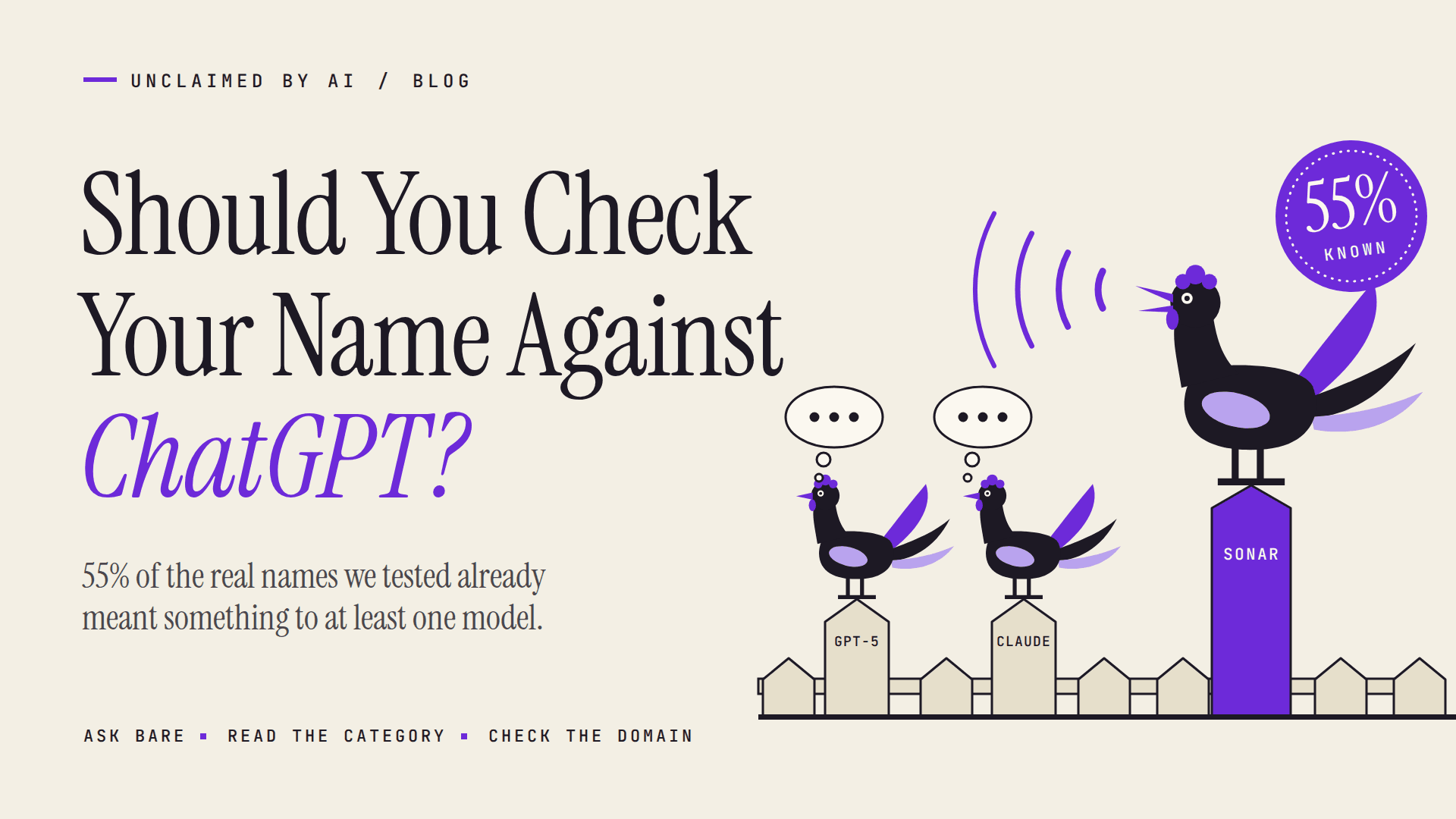
The short answer is yes, with one correction. ChatGPT alone is not enough, because different AI models know very different things about the same name. How different? We ran the numbers to find out.
Written by Victor Ohachor on
On this page
A name is not yours until the witnesses have nothing to say.
When I named this product, Unclaimed was my first choice. Its domain was already claimed. The irony has not left me, and neither has the lesson, which is that a name can be taken in ways you only discover at the worst possible time.
A taken domain is easy to find out. A registrar tells you in ten seconds. But while building this product, a quieter question kept bothering me: what if the domain is free, nobody has trademarked the name, and a chatbot still finishes your name with somebody else’s company?
That is the question founders now ask in every community I lurk in: "Should I check my business name against ChatGPT before I launch?" And it is usually answered with vibes. We sell a name check, so vibes are bad for our health.
The short answer is yes, with one correction. ChatGPT alone is not enough, because different AI models know very different things about the same name. How different? We ran the numbers to find out.
Is "Taken" Only One Thing?
Still unregistered, still suable, and already confusing are three different diseases.
When we say a name is taken, we are usually mixing up three separate problems.
| Collision | What it costs you | Who tells you | How you check |
|---|---|---|---|
| Domain | Your site, your email | The registrar, at launch | A live RDAP lookup |
| Trademark | Your legal safety | A lawyer, or a cease-and-desist letter | A trademark search |
| Memory | Your advertising’s working parts | Your first ad campaign | Blind model probes |
This post is about the third one. It is the youngest of the three and the only one nobody was checking a few years ago, because it barely existed.
What Does It Mean to Collide with AI Training Data?
A language model does not carry a registry of companies around in its head. It carries a compressed impression of a very large amount of published text, and when someone says a name, it completes the pattern it saw most often. It is reciting more than it is looking things up.
So here is the definition we work with, in a form you can quote:
Remember the tappers and listeners from the naming post? You know exactly what your name is supposed to mean, so you cannot hear it the way a stranger does. A model is the stranger you can actually interrogate. But there is a trap, and it is the same one I described in the HyDE post: the moment you hand a model your idea, you have given it a fake answer to lean on. Describe your product and the model will cheerfully tell you the name is brilliant, because you just gave it something to be helpful about.
So we ask bare. No pitch, no category, no audience. Just the name, and the model’s honest first reaction, like asking it "Wetin dey this name?" with nobody around to whisper the answer.
What Exactly Did We Ask?
Every probe used the same system prompt, the production one (version v1), copied word for word from the code that runs your checks:
You will be given a single word or short name in isolation, with no
other context. Report what you already know it refers to, if anything,
an existing company, product, public figure, place, or common
word/phrase. If you have no strong association, say so plainly; do
not invent one. Respond ONLY with JSON:
{"known_as": "...", "confidence": "none"|"weak"|"strong",
 "category": "company"|"product"|"person"|"place"|"common_word"|"none"}.
No prose, no markdown fences.
Then the name itself, one word or short phrase, with the temperature set to zero. We sent it to three models in parallel (openai/gpt-5, anthropic/claude-sonnet-5 and perplexity/sonar, the same trio every Unclaimed by AI check uses) through OpenRouter.
We tested 150 real names taken from our own search logs, which is the field sample. We also tested 30 famous brands (Spotify, Stripe, Notion, Airbnb, Wikipedia and their kin) as a control. If the models cannot flag those, the probe is broken and every other number in this post is decoration.
Of the 180 names, 177 got at least one successful probe. I will explain the other three in the limitations, because...I can :).
Verdicts follow production logic. Any model answering with strong confidence and a real category makes a name hard. A weak answer only makes it minor, and nothing meaningful makes it clean.
So, How Many Names Were Already Taken?
First, the control. All 30 famous brands were flagged strongly and unanimously, with GPT-5, Claude and Sonar each naming every single one. Zero misses. The instrument works.
Now the field sample, 147 real names that got at least one successful probe:
| Verdict | Names | Share |
|---|---|---|
| Hard (a strong association) | 57 | 38.8% |
| Minor (weak associations only) | 24 | 16.3% |
| Clean (nothing meaningful) | 66 | 44.9% |
If you take three numbers from this post, take these. 55.1% of the names founders actually searched already meant something to at least one model. 38.8% earned the verdict our product calls “rethink the name.” And of the 81 names flagged at all, 73 were flagged by exactly one model.
That last number is where the story really starts.
Why Did One Witness Do All the Talking?
Here are the per-model rates on the real names only (the control group would flatter them):
| Model | Any association | Strong | Failed probes |
|---|---|---|---|
| openai/gpt-5 | 6 of 134 (4.5%) | 4 of 134 (3.0%) | 16 |
| anthropic/claude-sonnet-5 | 7 of 125 (5.6%) | 2 of 125 (1.6%) | 25 |
| perplexity/sonar | 81 of 145 (55.9%) | 57 of 145 (39.3%) | 5 |
And here is how many models flagged each name:
| Flagged by | Names |
|---|---|
| No model | 66 |
| Exactly 1 model | 73 |
| Exactly 2 models | 3 |
| All 3 models | 5 |
Read the two tables together. All 73 single-model flags came from Sonar. GPT-5 and Claude never flagged a name alone, not even once. Every one of the 57 strong verdicts on real names had Sonar’s strong flag inside it.
You might think Sonar is simply the smarter witness, but that is not what happened. They are different kinds of witness. GPT-5 and Claude testify from memory, which is the compressed impression of the web they were trained on. A coined name that nobody has published about is a blank page to them, hence 4.5% and 5.6%. Sonar reads the newspaper. Perplexity's documentation shows every Sonar completion returning search results from the live web (Perplexity, n.d.), so it answers from what is published right now. That also explains why it was the slowest of the three, with a median of 2,061 ms against GPT-5’s 766 ms.
The person who reads every newspaper finds everything, including the small print. Sonar’s exclusive flags included a supplier listed in a Philippine government bidding document, a Vietnamese decorative hanging light and a Telegram channel handle. Not exactly your competitors, but not nothing either. Somewhere, someone already owns a piece of that name.
The witnesses also disagree about who owns a name:
| Name | GPT-5 said | Claude said | Sonar said |
|---|---|---|---|
| Narol | A town in Poland (strong) | A town in Manitoba (weak) | Both towns, plus companies using the name |
| Devair | Devair Alves Ferreira | The same man, the Brazilian scrap-metal dealer from the 1987 Goiânia radiological incident | A Brazilian given name, plus air-compressor brands |
| Solvion | SOLVION information management GmbH | “Not a recognized company” | An Austrian IT firm, a Korean payment app and a crypto token |
Three witnesses, three different trials. This is why "just ask ChatGPT" is both too much and too little. One model’s silence is not clearance, and one model’s alarm is not a conviction.
Is Every Strong Flag a Rival?
Read the category, not just the verdict.
Of the 57 strong flags on real names, here is what they were actually warning about:
| Category | Count | What it warns you about |
|---|---|---|
| company | 21 | Somebody is trading under your name |
| product | 15 | A product, library or drug already wears it |
| common_word | 10 | Your name is a word, which is an SEO problem |
| place | 7 | Your name is a town, which is also an SEO problem |
| person | 4 | Your name is somebody’s name, so watch what they rank for |
My favorite case was when I searched Sloppily. All three models, unanimously and strongly, identified it as an English adverb, so the verdict was hard. And technically the panel was right, since it agreed with total confidence that the name already means something. It just means something in the dictionary. The category tells you whether to rethink the name or rethink your SEO. Another founder checked Nextjs, and the panel, again unanimously, named Next.js. I would like to buy that founder a drink and a talk.
Can You Do This Yourself Tonight?
I would be a hypocrite to publish the method and then hoard it. The elders say Onye ajụjụ anaghị efu ụzọ (the one who asks does not lose his way), so here is how to ask.
- Ask three different models the bare prompt above. Open ChatGPT, Claude and Perplexity in three tabs right now, paste the prompt, then type only your name. No pitch, no category, no "it’s for a startup." Genuinely three different models, because as you just saw, they fail differently.
- Read the confidence and the category together. A strong company flag is a competitor. A strong
common_wordflag is a dictionary. A lone weak flag from one witness is a shrug. - Check the domain live through RDAP. A WHOIS mirror can be months stale. Test
.com,.ai,.ioand.co, the ones your people will actually type. - Check the handles. GitHub first, since its API tells the exact truth. Then X, Instagram, TikTok and YouTube, knowing that anything beyond an API is a best guess and should be labeled one.
- Come back in a week. Models remember slowly, but the web publishes daily and domains get taken daily.
Be honest with yourself about the time. With three tabs open, asking by hand takes a couple of minutes per name, and then you need notes, because you will not remember which of the three shrugged. Multiply that by a shortlist of a dozen names and you have an afternoon. Our panel runs the three models in parallel, so a full check cost two seconds at the median and 2.9 seconds at the 95th percentile across the 151 names where all three answered. The worst case in the entire study was 5.9 seconds. The whole study, all 540 probes, cost $2.03 in API credits.
Now, I could ask you to repeat those five steps for every name on your shortlist, and a few of you will, bless your patience. But I built Unclaimed by AI because I did not want to spend my own afternoons that way. You type a name once, and three models get the same bare question at the same time. The domain is checked live on .com, .ai, .io and .co, the handle is checked on five social platforms, and you get one verdict with each model’s answer sitting beside it, so you never have to remember who shrugged. Got a new name next month? Run it again. Nobody has ever re-run an afternoon by hand, and I doubt you will be the first.
What Does This Study Not Prove?
Every number above deserves its fine print.
- Association is not infringement. A strong flag is a branding signal. Trademark questions still belong to a lawyer, and Sloppily is a hard case, just not the kind you are worried about.
- The three witnesses read different things. Sonar’s 55.9% means the live web mentions this somewhere, and a Philippine supplier listing counts. GPT-5’s 4.5% means almost nothing famous matches, which is reassuring until the day after the training cutoff. You need both signals, labeled honestly.
- Model memory is not live. A domain registered yesterday is invisible to all three witnesses, which is why the domain half of a check must be a live RDAP query and never a model’s opinion.
- 46 of 540 probes failed, all with HTTP 402 from OpenRouter when concurrent bursts outran the credit balance (GPT-5: 16, Claude: 25, Sonar: 5). I report rates on successful probes only. Three names, Gabbroge, Galeclast and Jynqro, had no successful probe at all, so I excluded them from every verdict instead of quietly filling in. The failures stay in the raw log.
- This is a dated snapshot, run on October 21, 2026, against the model versions above with prompt v1. Models drift and prompts get revised, so I date mine and would rerun instead of quietly refreshing the percentages.
And since we sell this check, read our numbers the way you would read a prosecutor’s exhibits. The method is open, the raw data exists, and the jury is you. Ask and I will hand you the 540-line probe log, every response and every failure included. Oh, you already asked? That was fast!
In Closing...
A name is a bet on attention. Before you spend on a single ad, find out whether the witnesses are already working for somebody else. And remember that the answer depends on which witnesses you ask, which is the whole argument for asking all of them the same bare question.
If you want to read more, why name generators all sound the same is about picking a name worth checking, and on-page signals that AI crawlers look for is about making sure the world can find your claim once you make it.
Go check your name tonight. Then tell me what the witnesses said. I will be waiting on the transmission line.
References
OpenRouter. (n.d.). API reference overview. https://openrouter.ai/docs/api_reference/overview
Perplexity. (n.d.). Migrate from Sonar to the Agent API. https://docs.perplexity.ai/docs/agent-api/migrate-from-sonar/overview
Unclaimed by AI. (2026). Collision system prompt (Version v1) [Internal software].